Illawarra Hwy, Sutton Forest NSW
On the 20th March, 1798 white men first arrived in a place they described as “a fine open meadow country with fine green hills.” The area did not receive its present name until visited by Governor Macquarie on 2nd November, 1820, when he named it Sutton Forest after the Rt Hon. Charles Manners Sutton, then Speaker of the House of Commons and son of the Archbishop of Canterbury.
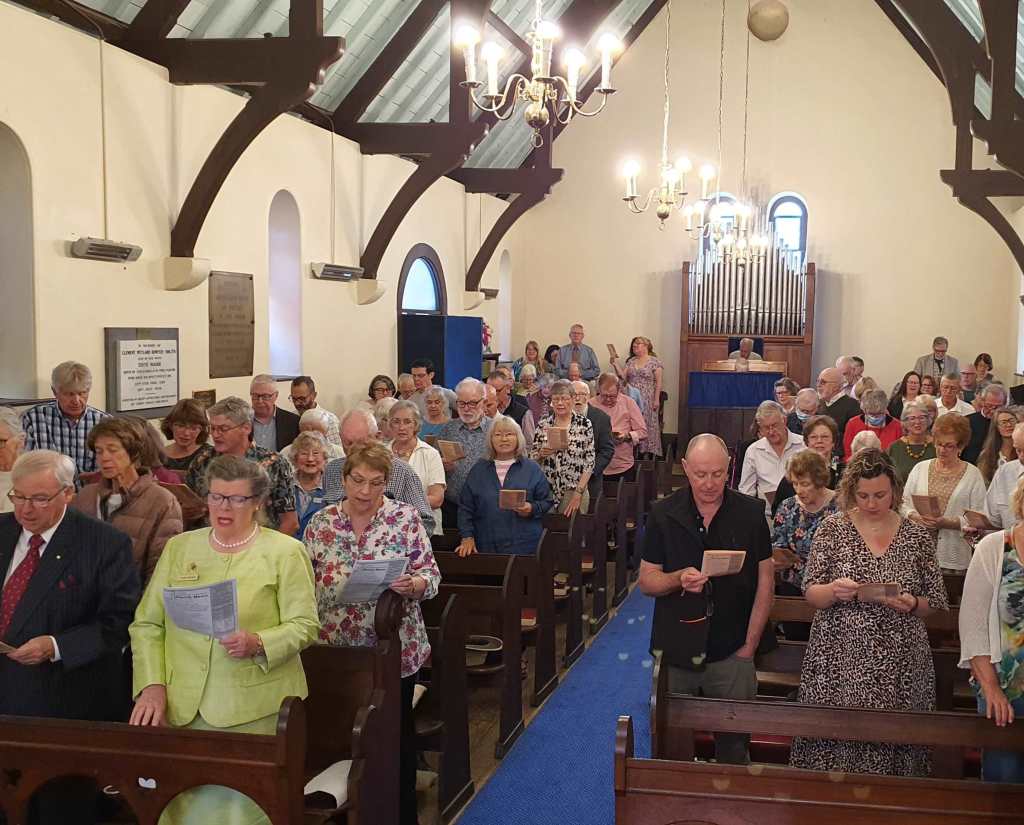
A graveyard was started on land given by Captain John Nicholson in 1828. A wooden chapel was opened and dedicated on 10th January, 1830, by Archdeacon (later Bishop) Broughton. This sacred site is the tenth oldest place of continuous Anglican worship in the Diocese of Sydney, and one of the oldest in Australia. The first Minister was Rev. Thomas Hassall, the “Galloping Parson”, who serviced the whole of southern NSW from his Rectory in Cobbitty. He was relieved of the responsibility for Sutton Forest by Rev. John Vincent as Chaplain in 1831, responsible for Mittagong southwards.
The wooden chapel soon proved insufficient and, after an attempt to build on land offered across the road, it was “proposed that the new church … be built on the same piece of ground as the present Church stands”. Edmund Blackett (the famous architect and designer of St Andrew’s Cathedral, Sydney) was consulted and he provided plans for the current church which was completed and dedicated by Bishop Frederick Barker on 29th August, 1861.
The organ was built in 1872 by C.J. Jackson. The church gates, originally from the Governor’s country residence, Hillside, were donated in 1959 in memory of NSW Governors who attended this church.
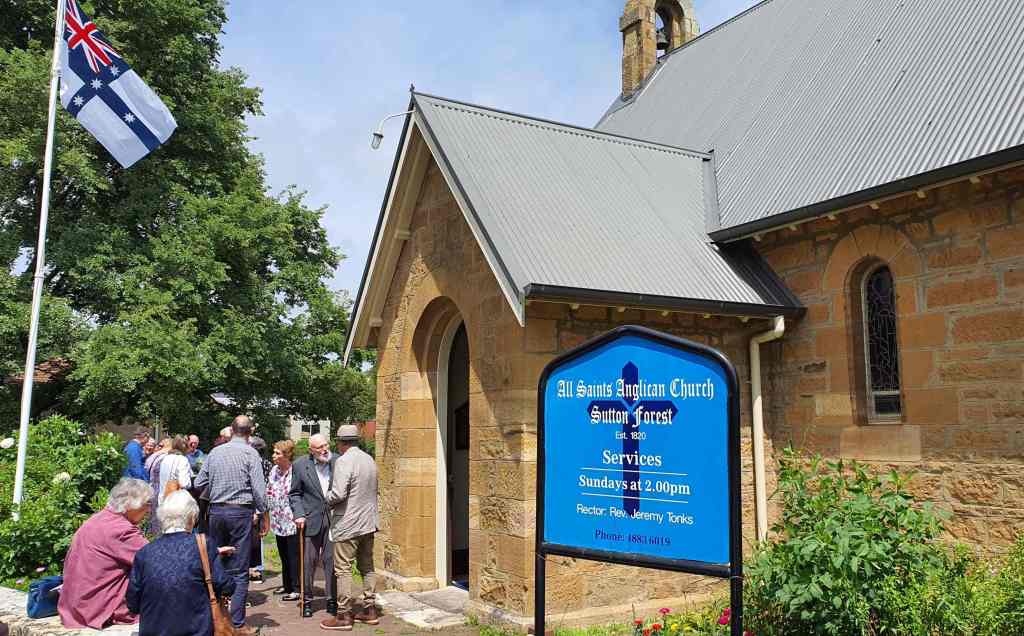
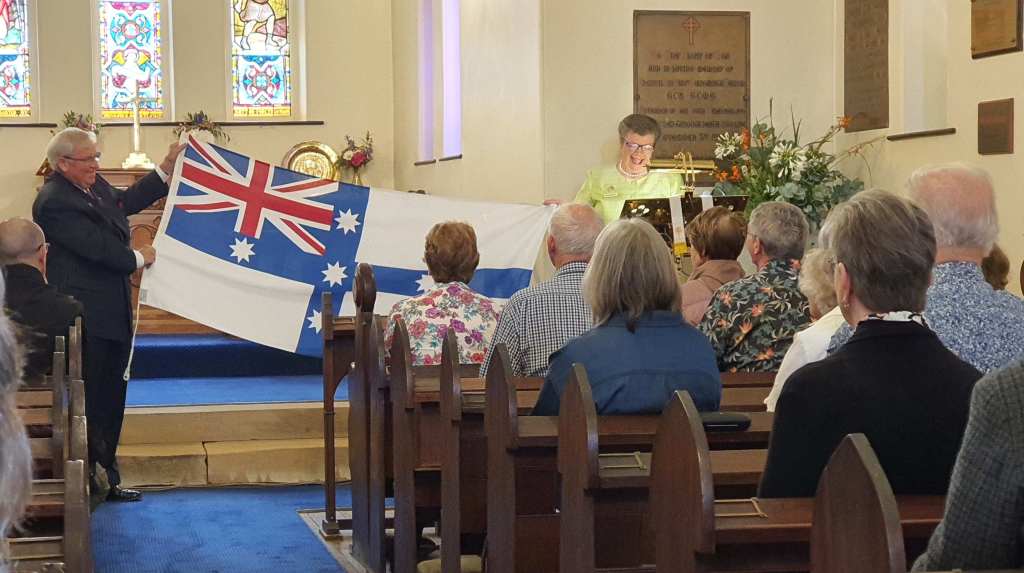
An Essay provided by Nerida B. for the flying of the Federation Flag on 7/1/24, in memory of Captain John Nicholson:
On 1st January, 2001, a ceremony was held in Sutton Forest to celebrate the Centenary of Federation. Our local Federal Member then, Jo Gash and Wingecarribee Shire Mayor, Phil Yeo were present. Together, they raised the Australian National Flag, exactly 100 years after its first appearance. It was mounted on one of the flagpoles that the Sutton Forest Business Association had erected in the village. Sutton Forest became the ‘Village of Australiana Flags’.
Along with the National and state and territory flags several more unusual flags were flown. The most interesting one was called the Federation Flag. This flag was nominated as our national flag by the Federation Movement when our colonies were being joined together as one nation across one continent. The flag’s design was first inspired in the 1820s by a Captain John Nicholson, formerly an officer in the British Royal Navy.
Our good friend and historian, Exeter’s Linda Emery, surprised us by saying this flag had truly come home. Sutton Forest owed more than the design of this beautiful flag to any Naval Captain. He was OUR Captain Nicholson, late of Sutton Forest!
In 1822 Nicholson was granted a parcel of 700 acres of land in Sutton Forest. It became known as Newbury Farm. Today we are sitting in timber pews made by our granddaughters’ antecedent in the 1880s, in a glorious sandstone church designed by Edmund Blackett. But none of this would have been possible without the generosity of John Nicholson who gave the land on which the church stands.
Who was Captain Nicholson?
John Nicholson was an 18 year old midshipman in the Royal Navy at the time of the Battle of Trafalgar in 1805. During the Napoleonic wars he saw action at the Battle of Copenhagen in 1807 where he had charge of a ‘prize’ ship. He was taken prisoner by the Dutch but escaped after three years’ internment. Nicholson served in the West Indies where he captured several French privateers.
Nicholson arrived in NSW in 1817. In the company of Gov. Macquarie, he raised the ship Lady Nelson. It had been wrecked in Newcastle. He delivered missionary families to Tahiti and other Pacific islands and he took the first coffee plants to Norfolk Island. Nicholson was given the post of Harbourmaster of Port Jackson in 1831. After his retirement from this post he presided on the bench as a magistrate in Berrima for 17 years.
Captain Nicholson died on 9th January 1863, 161 years ago, at Newbury Farm and his grave is just outside in the churchyard.
It now seems fitting that Captain Nicholson’s flag – the Australian Federation flag – should fly on the flagpole of All Saints Church, Sutton Forest, a small tribute to his patriotic service and Christian generosity.
 Anglican Parish of Sutton Forest - Knowing Christ - loving each other - serving our community - reaching the world